MRS_charm#
- class MCEq.charm_models.MRS_charm(e_grid, csm)[source]#
Bases:
CharmModelMartin-Ryskin-Stasto charm model.
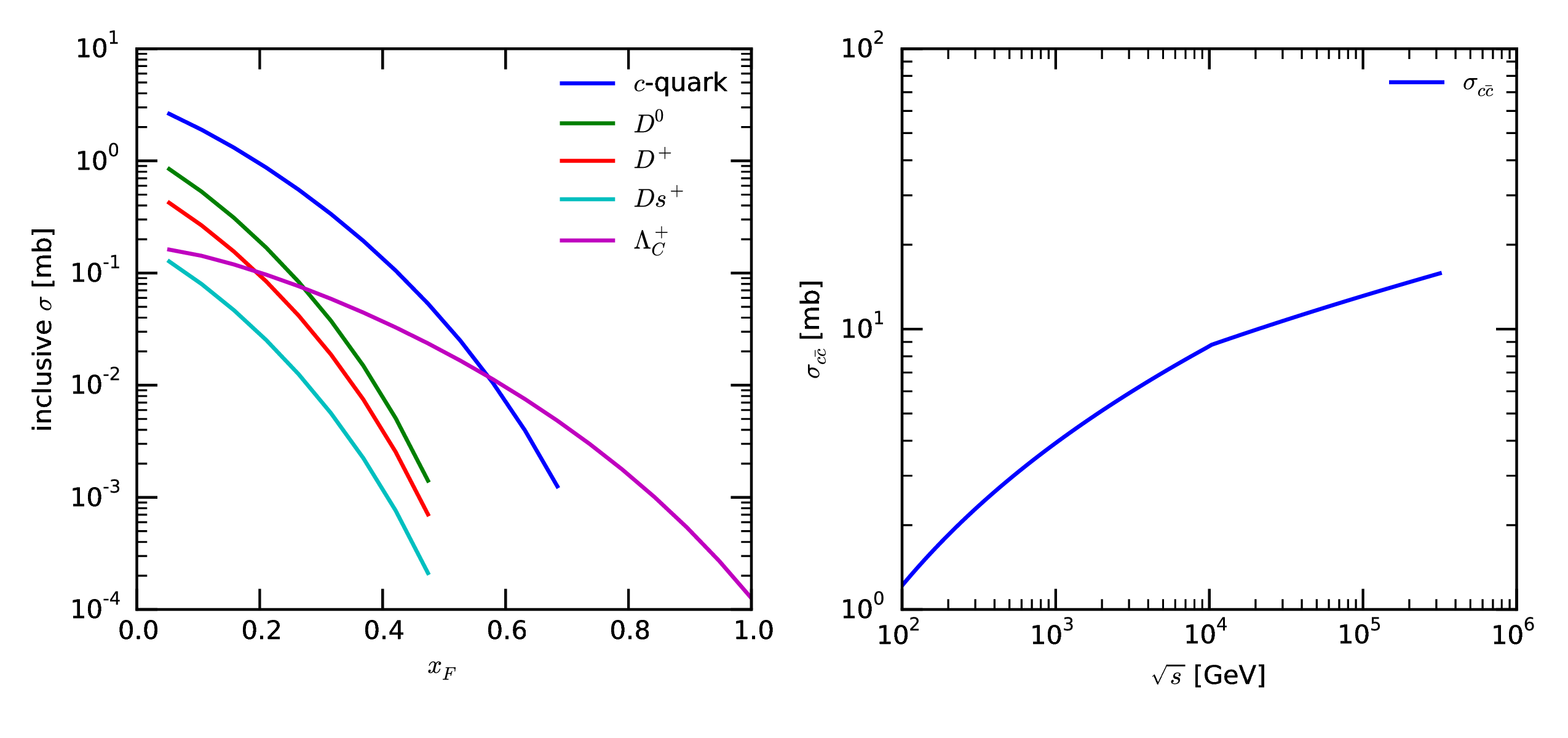
The model is described in A. D. Martin, M. G. Ryskin, and A. M. Stasto, Acta Physica Polonica B 34, 3273 (2003). The parameterization of the inclusive \(c\bar{c}\) cross-section is given in the appendix of the paper. This formula provides the behavior of the cross-section, while fragmentation functions and certain scales are needed to obtain meson and baryon fluxes as a function of the kinematic variable \(x_F\). At high energies and \(x_F > 0.05\), where this model is valid, \(x_F \approx x=E_c/E_{proj}\). Here, these fragmentation functions are used:
\(D\)-mesons \(\frac{4}{3} x\)
\(\Lambda\)-baryons \(\frac{1}{1.47} x\)
The production ratios between the different types of \(D\)-mesons are stored in the attribute
cs_scalesandD0_scale, whereD0_scaleis the \(c\bar{c}\) to \(D^0\) ratio andcs_scalesstores the production ratios of \(D^\pm/D^0\), \(D_s/D^0\) and \(\Lambda_c/D^0\).Since the model employs only perturbartive production of charm, the charge conjugates are symmetric, i.e. \(\sigma_{D^+} = \sigma_{D^-}\) etc.
- Parameters:
e_grid (np.array) – energy grid as it is defined in
MCEqRun.csm (np.array) – inelastic cross-sections as used in
MCEqRun.
Attributes Summary
D0 cross-section wrt to the ccbar cross-section
hadron projectiles, which are allowed to produce charm
charm secondaries, which are predicted by this model
fractions of cross-section wrt to D0 cross-section
Methods Summary
D_dist(x, E, mes)Returns the Feynman-\(x_F\) distribution of \(\sigma_{D-mesons}\) in mb
LambdaC_dist(x, E)Returns the Feynman-\(x_F\) distribution of \(\sigma_{\Lambda_C}\) in mb
dsig_dx(x, E)Returns the Feynman-\(x_F\) distribution of \(\sigma_{c\bar{c}}\) in mb
get_yield_matrix(proj, sec)Returns the yield matrix in proper format for
MCEqRun.sigma_cc(E)Returns the integrated ccbar cross-section in mb.
test()Plots the meson, baryon and charm quark distribution as shown in the plot below.
Attributes Documentation
- D0_scale = 0.47619047619047616#
D0 cross-section wrt to the ccbar cross-section
- allowed_proj = [2212, -2212, 2112, -2112, 211, -211, 321, -321]#
hadron projectiles, which are allowed to produce charm
- allowed_sec = [411, 421, 431, 4122]#
charm secondaries, which are predicted by this model
- cs_scales = {411: 0.5, 421: 1.0, 431: 0.15, 4122: 0.45}#
fractions of cross-section wrt to D0 cross-section
Methods Documentation
- D_dist(x, E, mes)[source]#
Returns the Feynman-\(x_F\) distribution of \(\sigma_{D-mesons}\) in mb
- Parameters:
x (float or np.array) – \(x_F\)
E (float) – center-of-mass energy in GeV
mes (int) – PDG ID of D-meson: \(\pm421, \pm431, \pm411\)
- Returns:
\(\sigma_{D-mesons}\) in mb
- Return type:
float
- LambdaC_dist(x, E)[source]#
Returns the Feynman-\(x_F\) distribution of \(\sigma_{\Lambda_C}\) in mb
- Parameters:
x (float or np.array) – \(x_F\)
E (float) – center-of-mass energy in GeV
mes (int) – PDG ID of D-meson: \(\pm421, \pm431, \pm411\)
- Returns:
\(\sigma_{D-mesons}\) in mb
- Return type:
float
- dsig_dx(x, E)[source]#
Returns the Feynman-\(x_F\) distribution of \(\sigma_{c\bar{c}}\) in mb
- Parameters:
x (float or np.array) – \(x_F\)
E (float) – center-of-mass energy in GeV
- Returns:
\(\sigma_{c\bar{c}}\) in mb
- Return type:
float
- get_yield_matrix(proj, sec)[source]#
Returns the yield matrix in proper format for
MCEqRun.- Parameters:
proj (int) – projectile PDG ID \(\pm\) [2212, 211, 321]
sec (int) – charmed particle PDG ID \(\pm\) [411, 421, 431, 4122]
- Returns:
- yield matrix if (proj,sec) combination allowed,
else zero matrix
- Return type:
np.array