config (MCEq.config)#
These are all options MCEq accepts. Usually there is no need to change, except for advanced scenarios. Check out the file for a better formatted description and some advanced settings not contained in the list below.
Reference/API#
MCEq.config Module#
Functions#
Download the MCEq database if not already present. |
|
|
Classes#
|
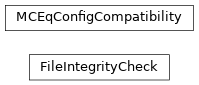
A class to check a file integrity against provided checksum |
|
This class provides access to the attributes of the module as a dictionary, as it was in the previous versions of MCEq |
Variables#
Average target mass (for interaction length calculations) Change parameter only in combination with interaction model setting. |
|
Convert a string or number to a floating-point number, if possible. |
|
Advanced settings (some options might be obsolete/not working) |
|
Assume nucleon, pion and kaon cross sections for interactions of rare or exotic particles (mostly relevant for non-compact mode) |
|
Improve (explicit solver) stability by averaging the continous loss operator |
|
str(object='') -> str str(bytes_or_buffer[, encoding[, errors]]) -> str |
|
str(object='') -> str str(bytes_or_buffer[, encoding[, errors]]) -> str |
|
CUDA Floating point precision (default 32-bit 'float') |
|
Select CUDA device ID if you have multiple GPUs |
|
Maximal integration step dX in g/cm2. |
|
Directory where the data files for the calculation are stored |
|
Debug flag for verbose printing, 0 silences MCEq entirely |
|
(model, (arguments)) |
|
The maximal energy is 1e12 GeV, but not all interaction models run at such high energies. |
|
Minimal energy for grid The minimal energy (technically) is 1e-2 GeV. |
|
File name of the MCEq database |
|
Treat radiation (bremsstrahlung) as continuous loss, disable if explicit electromagnetic cross sections available |
|
Enable default tracking particles, such as pi_numu, pr_mu+, etc. |
|
Enable electromagnetic cascade with matrices from EmCA |
|
enable EM ionization loss for electrons and positrons |
|
Ionization and radiative losses according to stopping power tables (PDG) |
|
density of default material in g/cm^3 |
|
str(object='') -> str str(bytes_or_buffer[, encoding[, errors]]) -> str |
|
Raise exception when requesting unknown particles from get_solution |
|
Fall-back to air production matrices if medium not included in data file |
|
str(object='') -> str str(bytes_or_buffer[, encoding[, errors]]) -> str |
|
Floating point precision (is set automatically) |
|
Apply stopping power to all charged hadrons (muon dEdX is used and is ~ok) |
|
Convert a string or number to a floating-point number, if possible. |
|
Convert a string or number to a floating-point number, if possible. |
|
bool(x) -> bool |
|
bool(x) -> bool |
|
bool(x) -> bool |
|
Ratio of decay_length/interaction_length where particle interactions are neglected and the resonance approximation is used 0.5 ~ precision loss <+3% speed gain ~ factor 10 If smoothness and shape accuracy for prompt flux is crucial, use smaller values around 0.1 or 0.05 |
|
Selection of integrator (euler/odepack) |
|
Material for interaction lengths, ionization and radiation (=continuous) loss terms Currently available choices: 'air', 'water', 'ice', 'rock', 'co2', 'hydrogen', 'iron' |
|
euler kernel implementation (numpy/MKL/CUDA/accelerate). |
|
The leading process is can be either "decays" or "interactions". |
|
Default parameters for GeneralizedTarget Total length of the target [m] |
|
Step size (dX) for averaging |
|
This is not used in the code as before, instead the low energy extension is compiled into the HDF backend files. |
|
Approximate value for the maximum density expected. |
|
File name of the MCEq database |
|
Convert a string or number to a floating-point number, if possible. |
|
Built-in mutable sequence. |
|
Path subclass for non-Windows systems. |
|
Number of MKL threads (for sparse matrix multiplication the performance advantage from using more than a few threads is limited by memory bandwidth) Irrelevant for GPU integrators, but can affect initialization speed if numpy is linked to MKL. |
|
Helicity dependent muons decays from analytical expressions |
|
parameters for the odepack integrator. |
|
Override debug prinput for functions listed here (just give the name, "get_solution" for instance) Warning, this option slows down initialization by a lot. |
|
Override debug printout for debug levels < value for the functions above |
|
Autodetect best solver determine shared library extension and MKL path |
|
Path subclass for non-Windows systems. |
|
Print module name in debug output |
|
Convert a string or number to a floating-point number, if possible. |
|
parameters for EarthGeometry |
|
str(object='') -> str str(bytes_or_buffer[, encoding[, errors]]) -> str |
|
The latest versions of MCEq work in kinetic energy not total energy If you want the result to be compatible with the previous choose 'total energy' else 'kinetic energy' |
|
Stability margin for the integrator. |
|
Particles for compact mode |
|
When using modified particle production matrices use isospin symmetries to determine the corresponding modification for neutrons and K0L/K0S |
Class Inheritance Diagram#